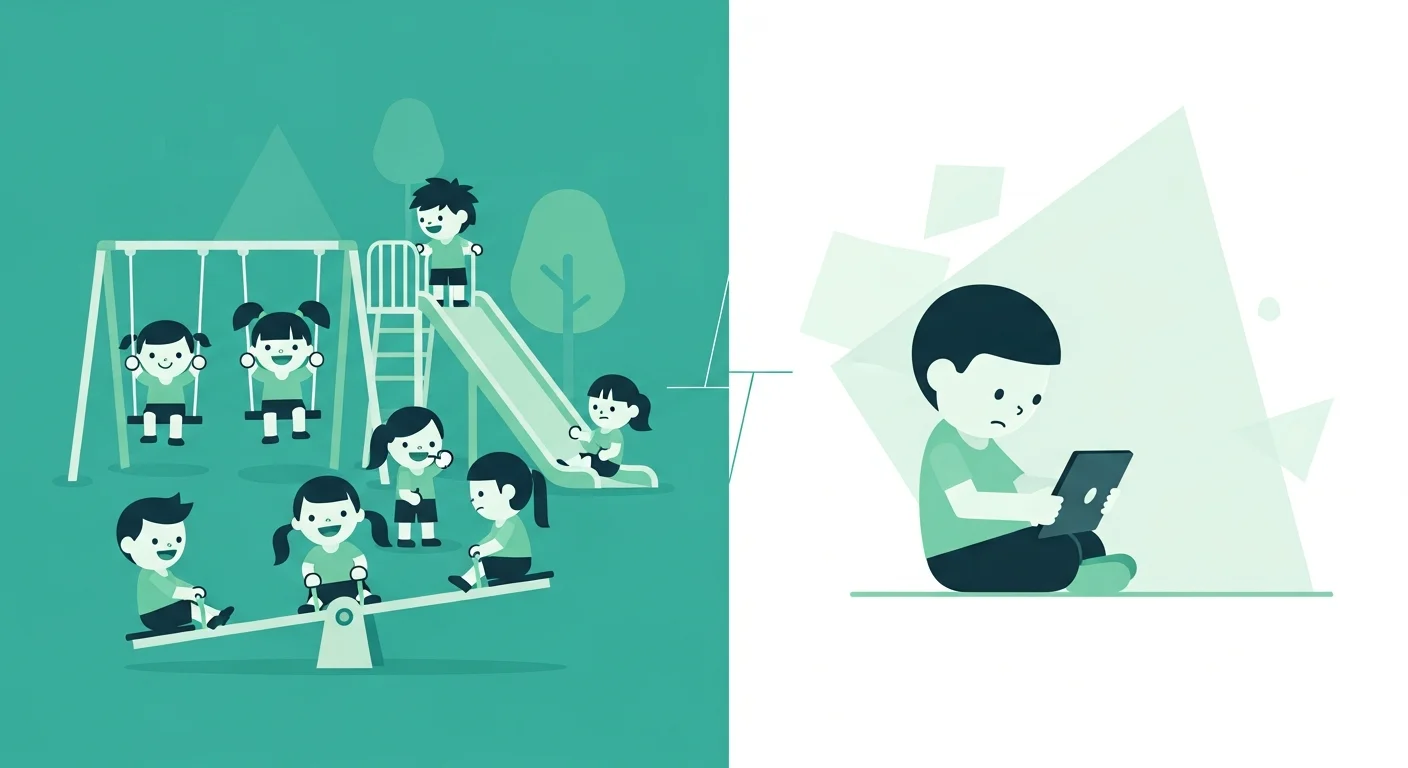
I'll be honest with you. Last Tuesday, I watched my neighbor's seven-year-old spend an entire playdate staring at an iPad while his friend sat beside him, doing the same thing. They were in the same room, but they might as well have been on different planets. That moment hit me harder than any research study could, and it's exactly why we need to talk about screen time and children's social skills.
Here's the thing nobody wants to admit: we've accidentally created a generation that's more comfortable swiping than speaking. The digital media effects on our children's social development aren't some distant concern anymore. They're showing up in kindergarten classrooms, at birthday parties, and around dinner tables everywhere.
The Real Cost of Screen Time on Social Learning
You know what's fascinating? Child psychology experts are now seeing patterns they've never encountered before. Kids who spend excessive time with screens are developing what I call "social muscle atrophy." Just like your body needs movement to stay strong, young minds need real human interaction to build those crucial interpersonal abilities. When tablets replace tag and video games substitute for actual conversation, something fundamental gets lost in translation.
The effects of screens on kids' social learning show up in unexpected ways. I've talked to teachers who notice students struggling with basic things like reading facial expressions, picking up on social cues, or handling conflict without melting down. These aren't bad kids or poor parenting situations. These are smart, capable children who simply haven't had enough practice navigating the messy, beautiful complexity of face-to-face human connection. Think about it: when you're behind a screen, you can edit, delete, or simply walk away from uncomfortable moments. Real life doesn't give you that luxury, and that's actually where the magic happens.
| Screen Time Duration | Social Skill Impact | Peer Interaction Quality |
|---|---|---|
| Less than 1 hour/day | Minimal effects | Strong engagement |
| 2-3 hours/day | Moderate challenges | Reduced spontaneity |
| 4+ hours/day | Significant delays | Frequent withdrawal |
Can Reducing Device Time Actually Transform Friendships?
Here's where it gets interesting. Does limiting screens improve children's peer interactions? Absolutely, but not instantly like flipping a switch. When families start reducing device time for better child friendships, they typically see changes within weeks, not days. Kids rediscover boredom, which sounds terrible but is actually where creativity lives. They start initiating games, inventing stories, and yes, sometimes arguing with siblings. Those arguments? They're actually teaching negotiation, compromise, and emotional regulation in ways that no educational app ever could.
The connection between social media and young social behaviors deserves special attention. Platforms designed for adults are shaping how children view relationships, popularity, and self-worth. When your child's understanding of friendship gets filtered through likes, comments, and follower counts, we're setting them up for some serious confusion about what real connection looks like. Social media impact on young minds creates a distorted mirror where performance matters more than presence.
What About Screen Dependency and Social Withdrawal?
This is where parents usually start feeling that knot in their stomach. Screen Dependency in children doesn't always look like what you'd expect. It's not just the kid throwing tantrums when you take away the device (though that happens). It's the gradual social withdrawal, the preference for digital interaction over real play, the anxiety around unstructured social time. I've seen children who can coordinate complex team strategies in online games but freeze completely when asked to join a neighborhood soccer game.
Building Screen Limits That Actually Boost Empathy Skills
So how do we fix this? Setting screen limits to boost children's empathy skills isn't about becoming the fun police. It's about creating space for the kind of experiences that build emotional intelligence. When kids engage in imaginative play, navigate playground politics, or work through the disappointment of not being picked first for teams, they're developing empathy in real-time. These moments teach them that other people have feelings, perspectives, and needs that matter just as much as their own.
Balancing tech with social skill building in kids means being intentional. Instead of banning screens completely (which rarely works anyway), try this: for every hour of screen time, require an hour of face-to-face interaction. Notice how tablets affect family social bonding during dinner. Put devices in a basket during meals and actually talk to each other. Yes, it'll be awkward at first. Yes, your teenager will act like you've suggested something ridiculous. Do it anyway.
The Age Factor Nobody Talks About
Are there age-specific impacts of screens on social development? You bet. A three-year-old missing out on social play faces different challenges than a thirteen-year-old living on social media. Younger children need physical play and face-to-face interaction to develop basic social foundations. They're literally building the neural pathways that will support all future relationships. Older kids need practice navigating complex social dynamics, reading rooms, and developing their identity within peer groups. Video games and children's real-world interactions need careful monitoring because the skills required for each are genuinely different.
Age-Appropriate Screen Time Guidelines:
| Age Group | Recommended Daily Limit | Focus Priority |
|---|---|---|
| 0-18 Months | None (except video chat) | Physical bonding & voice |
| 18-24 Months | Minimal (high quality) | Co-viewing with parents |
| 2-5 Years | 1 hour max / day | Creative & social play |
| 6-12 Years | Consistent limits (1-2 hrs) | School, sleep, physical activity |
| Teens | Balanced approach | Sleep, social, & mental health |
The Bottom Line
Look, I'm not suggesting we go back to some screen-free utopia that never really existed anyway. Technology isn't going anywhere, and honestly, it shouldn't. But we need to stop pretending that virtual interaction equals real social development. It doesn't. Our children need us to protect their childhood social experiences the same way we protect their physical health.
The question isn't whether screens affect social skills anymore. We know they do. The real question is: what are you going to do about it? Start small. Put phones away during dinner tonight. Take your kid to the park and leave the iPad at home. Let them be bored. Let them figure out how to talk to that kid on the swings. Give them back the messy, imperfect, absolutely essential experience of being human with other humans.
What changes will you make this week to prioritize real-world connections for your child? Drop your thoughts below.