Picture this: You're exhausted, dinner needs cooking, and your toddler is melting down. You hand over the iPad, and suddenly, blissful silence. Peace. Thirty precious minutes to breathe. I get it. I've been there, watching that screen become an electronic pacifier while guilt gnaws at the edges of my consciousness. But here's what nobody tells you at those chaotic moments: every minute your toddler spends mesmerized by that glowing rectangle is a minute they're not learning to talk, not practicing the intricate dance of human communication that shapes their entire future.
The research on screen time effects on toddler language development has been piling up for years now, and honestly, it's pretty sobering stuff. We're discovering that those little brains are hardwired to learn language through face-to-face interaction, through the back-and-forth rhythm of conversation, through watching mouths form words and reading facial expressions. Screens, no matter how educational they claim to be, can't replicate that biological necessity. And the consequences of substituting digital content for human connection during these critical early years show up in ways that surprise most parents.
How Does Screen Time Affect My Toddler's Language Development?
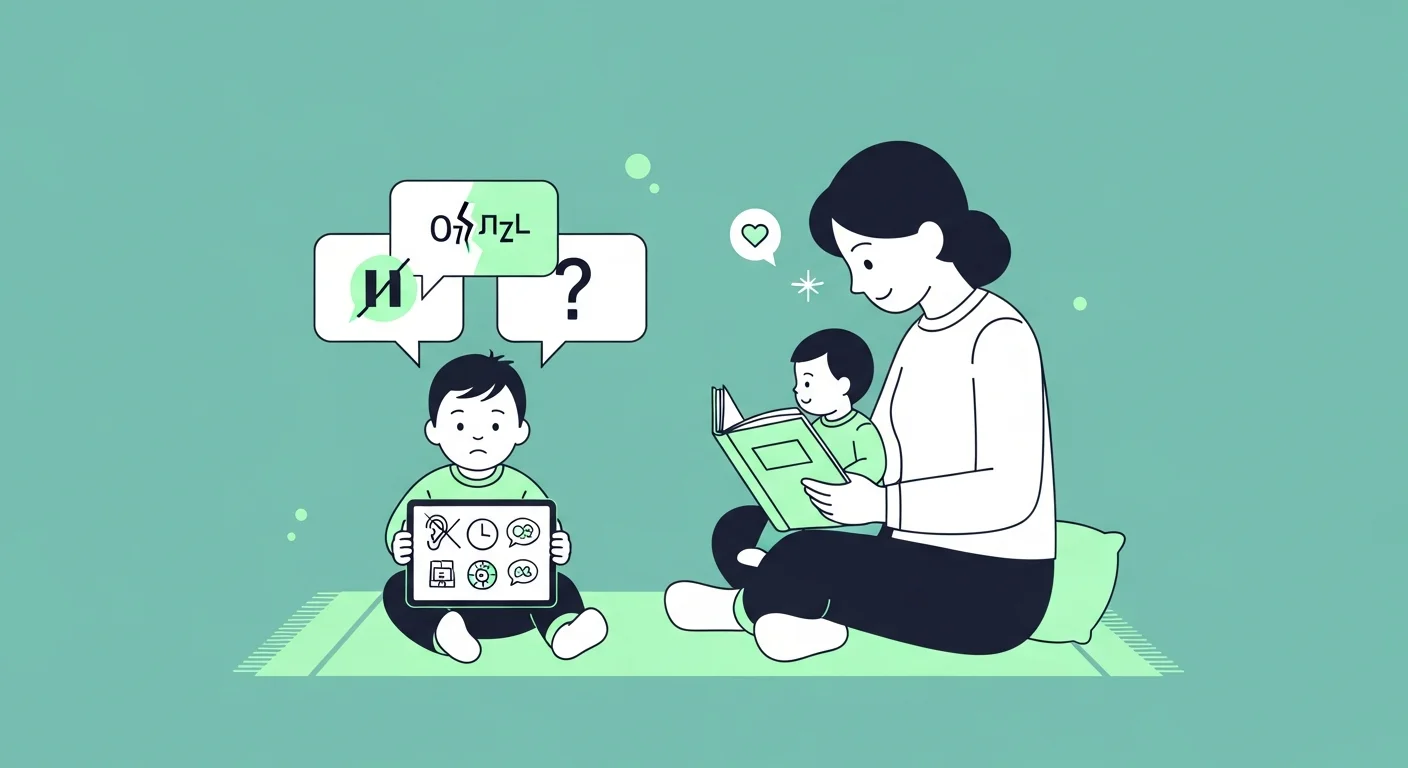
The connection between screen time and language delay in toddlers operates through multiple pathways that all converge on one central problem: displacement of real conversation. Think about what happens when your two-year-old is watching Cocomelon or playing with an educational app. They're passive receivers of language rather than active participants in it. Language acquisition isn't like downloading software. It requires interactive practice, immediate feedback, and the kind of joint attention that only happens when two humans focus on the same thing together while talking about it.
Every hour spent on screens represents an hour not spent in the verbal gymnastics that build language skills. Toddlers need thousands of repetitions, corrections, extensions, and elaborations to wire their brains for language. When your child points at a dog and you respond with "Yes! That's a big brown dog! The dog says woof woof! Do you hear the dog?" you're providing scaffolding that no app can match. You're modeling sentence structure, introducing adjectives, demonstrating conversational turn-taking, and reading their engagement level to adjust your response accordingly. Screens offer none of this dynamic, responsive interaction that drives expressive language and receptive language development simultaneously.
Research tracking how screen time affects toddler speech shows measurable delays in vocabulary acquisition, sentence complexity, and conversational abilities. For every 30 minutes of daily screen exposure, studies document decreases in the number of vocalizations toddlers produce, reductions in conversational turns with caregivers, and delays in reaching language milestones. The most troubling finding? These effects persist even when controlling for other factors like socioeconomic status, parental education, and overall parent-child interaction quality. Screen time creates an independent risk factor that operates regardless of other positive influences in a child's environment.
How Much Screen Time Is Okay for a 2-Year-Old?
Here's where pediatric guidelines get really specific, and for good reason. The American Academy of Pediatrics recommends avoiding screens entirely for children under 18 to 24 months, with the sole exception of video calls with family members. After age two, the recommended screen time for 2-year-olds language development should remain extremely limited, ideally under one hour daily of high-quality programming, and always with a caregiver present to mediate the experience. These aren't arbitrary restrictions designed to make parenting harder. They're based on decades of research into early childhood development and the specific needs of developing brains.
Screen Time Guidelines and Language Impact:
| Age Range | Recommended Daily Limit | Language Development Considerations |
|---|---|---|
| Under 18 months | Zero (except video calls) | Critical period for neural language pathways |
| 18-24 months | Very minimal, co-viewing only | Vocabulary explosion phase needs interaction |
| 2-3 years | Maximum 1 hour, supervised | Sentence formation requires practice opportunities |
| 3-5 years | Maximum 1 hour, quality content | Conversational skills develop through dialogue |
The thing about these limits that most parents miss is the reasoning behind them. Between 18 and 36 months, toddler brains undergo explosive language development, adding dozens of words weekly and beginning to combine them into sentences. This growth doesn't happen automatically. It requires massive amounts of linguistic input paired with opportunities for output. When screens fill the time that should be spent in conversation, singing, reading, and verbal play, the neural pathways responsible for language processing simply don't develop as robustly. You can't make up for lost time later. These early years represent a developmental window that closes, and what doesn't get built during this period requires exponentially more effort to construct afterward.
Is Educational TV or Apps Good or Bad for My Toddler's Language Skills?
This is where things get nuanced in ways that marketing departments really don't want you to understand. Educational apps and toddler language skills exist in a complicated relationship that depends entirely on context. Programs marketed as educational for toddlers, shows with bright colors and repetitive songs promising to teach letters and numbers, these don't actually boost language development when toddlers watch them alone. The research is unequivocal on this point. Passive viewing of educational content produces minimal to zero language gains, regardless of how cleverly the content is designed or how many parenting awards it's won.
However, and this is crucial, co-viewing screen time with toddlers benefits changes the equation dramatically. When you watch alongside your child, pausing to point out objects, asking questions, repeating and expanding on words from the program, connecting screen content to real-world experiences, you transform passive consumption into active learning. The screen becomes a conversation starter rather than a conversation ender. "Look, that character is eating an apple! We had apples for snack today, remember? Red apples. Crunch crunch!" This kind of mediated screen time can supplement language learning, though it still can't replace the unstructured, spontaneous conversations that happen during play, meals, and daily routines.
The background TV impact on toddler communication deserves special mention because it's so insidious. Many households keep television running constantly as ambient noise, and parents often don't realize this counts as screen exposure. Background television, even when a toddler isn't actively watching it, reduces the quantity and quality of parent-child interaction. Adults speak fewer words, use simpler sentences, and respond less attentively to children's attempts at communication when TV plays in the background. Toddlers vocalize less frequently and engage in shorter conversational exchanges. It's like trying to have a meaningful conversation at a loud party. The background noise creates interference that disrupts the delicate process of language learning.
Building Better Language Through Real Connection
Understanding screen time effects on toddler language development isn't about perfect parenting or never letting your kid watch anything. It's about recognizing that those early years represent an irreplaceable opportunity to wire young brains for communication. Every conversation, every song, every silly word game builds neural architecture that supports not just language but thinking, social connection, and academic success throughout life. Screens aren't evil, but they're terrible language teachers when used as solo entertainment for toddlers whose brains are desperately hungry for human interaction.
What's one screen-free activity you could introduce today to boost your toddler's language skills? Start there, and watch their vocabulary blossom through the magic of your undivided attention.