I had a panic attack in a coffee shop last month because my phone died. Not because I was expecting an emergency call or waiting for critical news. My phone just hit zero percent, and suddenly my chest tightened, my breathing got shallow, and I felt this overwhelming need to leave immediately and find a charger. Sitting there trying to calm down, I realized something unsettling: my phone wasn't just a convenience anymore. It had become a psychological crutch, and without it, my anxiety spiked like I'd lost a vital organ. That moment forced me to confront an uncomfortable truth about the relationship between Phone Overuse and anxiety, one that's affecting millions of us in ways we barely recognize.
How Does Smartphone Overuse Contribute to Heightened Anxiety Levels?
The connection between Smartphone Dependency and stress operates through multiple psychological mechanisms that compound over time, creating a feedback loop that's difficult to escape. Every time you check your phone and find a notification, your brain releases a small hit of dopamine, the same neurotransmitter involved in reward-seeking behavior and addiction. This conditions your brain to constantly anticipate the next notification, the next like, the next message. When those rewards don't come as expected, or when you're separated from your phone, your brain experiences something akin to withdrawal. Studies measuring cortisol levels in people separated from their smartphones show significant spikes, similar to the stress response triggered by actual threatening situations. Your body literally interprets being without your phone as a form of danger.
But the anxiety doesn't just come from separation. Constant connectivity itself creates chronic low-level stress that accumulates throughout the day. You're perpetually available, perpetually interrupted, perpetually aware of everything happening in your social circles, your work environment, and the chaotic wider world through news feeds and social media. Your nervous system never gets a break from stimulation. Think about it: our brains evolved to handle immediate, local concerns, not to process hundreds of micro-interactions and information streams simultaneously. The cognitive load of managing multiple apps, conversations, and information sources keeps your brain in a state of hypervigilance that manifests as anxiety. You might not even recognize it as anxiety because it's become your baseline, but that constant background tension, that feeling of always being slightly on edge, that's smartphone-induced stress wearing you down bit by bit.
What Is the Relationship Between Screen Dependency and Mental Health Issues Like Anxiety?
The relationship between screen time and anxiety isn't just correlational, there's growing evidence it's causal in many cases. Research has found that people who use their phones for more than five hours daily are twice as likely to experience anxiety symptoms compared to moderate users. But here's where it gets interesting: reducing screen time actually improves anxiety symptoms in controlled studies, suggesting the relationship works both ways. When participants cut their social media use to 30 minutes per day for three weeks, researchers observed significant decreases in anxiety and depression scores. This isn't just correlation anymore, it's intervention evidence showing that mobile overuse and mental health are directly connected in ways we can measure and modify.
Social media platforms in particular create what psychologists call "comparison anxiety," where you're constantly measuring your life against the carefully curated highlights of everyone else's lives. You see friends on vacation, colleagues getting promotions, acquaintances posting about their perfect relationships or their fitness achievements, and your brain processes this as evidence that you're falling behind. The rational part of you knows that social media isn't real life, that everyone's showing their best moments while hiding their struggles, but the emotional part of your brain doesn't care about that logic. It just registers: everyone else seems happier, more successful, more put-together. Studies on mobile addiction and mental anxiety show that this chronic comparison creates persistent feelings of inadequacy and worry that meet clinical criteria for generalized anxiety in many heavy users.
Can Excessive Mobile Use Trigger or Worsen Anxiety Symptoms?
For people who already have anxiety disorders, phone habits can worsen generalized anxiety in ways that are particularly insidious. Take someone with existing anxiety who uses their phone as a coping mechanism. Feeling anxious? Check your phone. Feeling socially awkward? Stare at your phone. Avoiding a difficult task? Scroll through your phone. This creates a behavioral pattern where the phone becomes your go-to escape from uncomfortable feelings. But here's the problem: avoidance doesn't treat anxiety, it reinforces it. Every time you reach for your phone instead of sitting with discomfort or addressing the source of your anxiety, you're teaching your brain that the anxiety is too dangerous to face directly. Over time, this makes your baseline anxiety worse because you never build tolerance or develop healthier coping strategies.
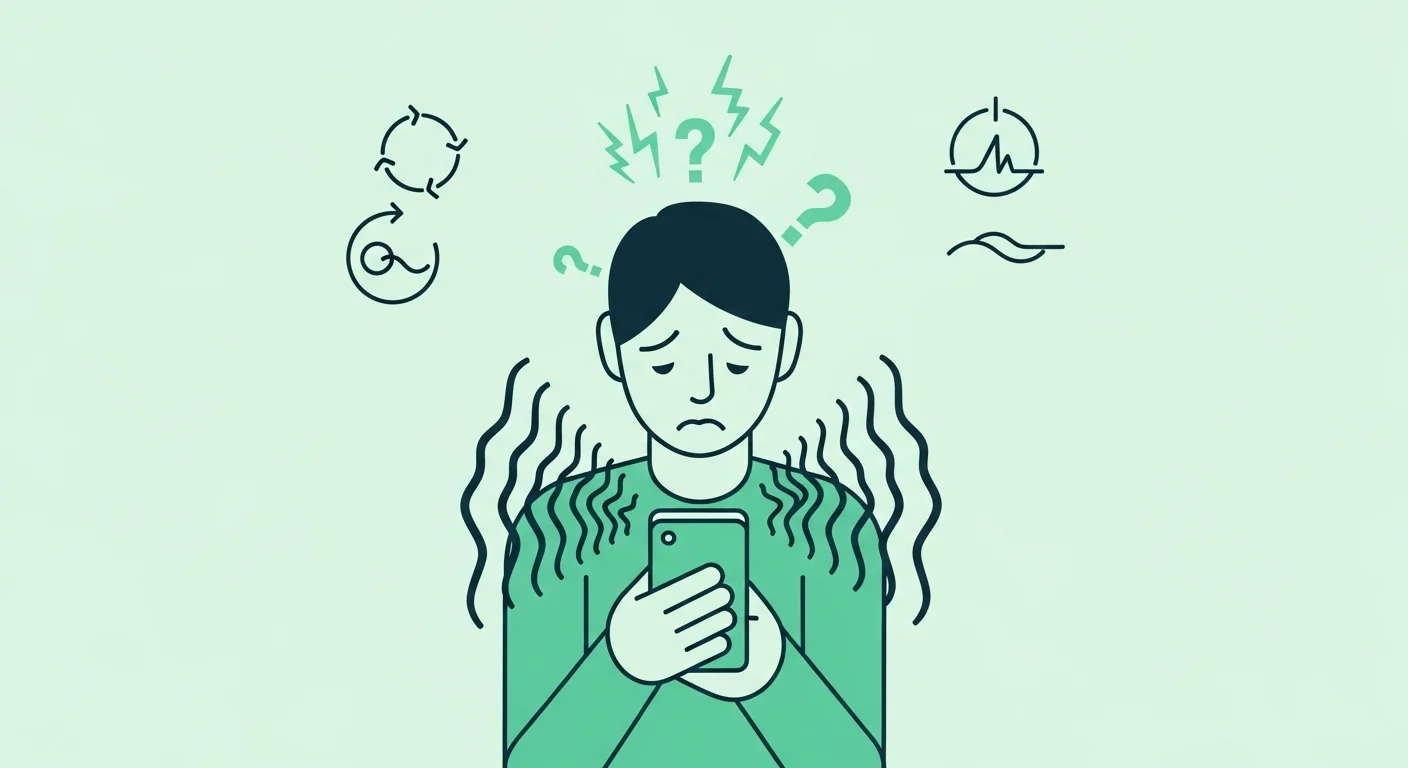
The connection between Screen Dependency and panic attacks is particularly concerning and surprisingly common. Many people experience what's essentially nomophobia, the fear of being without your mobile phone, without recognizing it as an actual phobia. Symptoms include rapid heartbeat, shortness of breath, dizziness, and overwhelming dread when separated from your device or when it's running low on battery. One study found that nearly 60% of smartphone users experience moderate to severe nomophobia, reporting genuine distress when unable to access their phones. This isn't just "really liking your phone," it's anxiety that meets clinical thresholds and sometimes manifests as full panic attacks. I've talked to people who've had panic attacks because they couldn't find their phone in their apartment, only to find it two minutes later in their jacket pocket. The speed and intensity of that anxiety response reveals how deeply the phone dependency has embedded itself in their nervous system.
Why Does Phone Dependency Often Lead to Increased Feelings of Worry?
Phone Overuse fuels chronic anxiety through what I call the "perpetual incompleteness loop." Your phone always has more notifications to check, more messages to answer, more content to consume. There's never a moment where you can say "I'm done, I've completed everything." This creates a constant background hum of unfinished business that your brain interprets as worry. Even when you're not actively using your phone, part of your mental bandwidth is allocated to wondering what you might be missing, whether someone has messaged you, whether something important has happened that you don't know about yet. This is why excessive texting increases anxiety levels, it's not the texting itself but the endless nature of it. Conversations that used to have natural endpoints now continue indefinitely across days or weeks, leaving you in a state of perpetual response obligation.
The FOMO (fear of missing out) phenomenon amplifies this worry considerably. When you see friends posting about activities you weren't invited to, or when you observe everyone commenting on something you haven't seen yet, your brain activates the same regions associated with social rejection and exclusion. For our ancestors, being excluded from the group was a legitimate survival threat. Your modern brain doesn't fully distinguish between being left out of a group chat and being exiled from the tribe, it just registers social exclusion and triggers anxiety accordingly. Breaking phone overuse to reduce anxiety symptoms often means confronting this FOMO head-on and accepting that you will miss things, that you can't be everywhere and know everything, and that's actually okay.
How Are Digital Habits Linked to Anxiety Disorders?
The digital habits that link most strongly to anxiety disorders share common patterns: compulsive checking, social comparison, information overload, and disrupted sleep. Each of these mechanisms independently contributes to anxiety, but together they create a perfect storm of chronic worry and stress. The blue light from screens suppresses melatonin production, disrupting your circadian rhythm and reducing sleep quality. Poor sleep directly increases anxiety because your brain doesn't get adequate time to process emotions and reset stress hormones. Meanwhile, the constant information stream from news apps and social media keeps your amygdala, your brain's threat-detection center, in a state of activation. You're exposed to threats and negative events from around the world, things you have no control over, and your brain doesn't know how to process that effectively.
What's becoming clear from recent research is that Phone Overuse doesn't just coexist with anxiety, in many cases it's a primary driver. Studies show that when people reduce their smartphone use, anxiety symptoms improve even without other interventions. This suggests that for a significant subset of people experiencing anxiety, their digital habits aren't just making existing anxiety worse, they're actually creating the anxiety in the first place.
Breaking the Cycle
Understanding the connection between Phone Overuse and anxiety is the first step toward breaking the cycle. If you've recognized yourself in any of these patterns, that awareness itself is valuable. Start by noticing when you reach for your phone and what you're feeling right before that impulse. Anxiety? Boredom? Avoidance? That simple observation, without judgment, begins to interrupt the automatic pattern. Your phone isn't evil, but it might be making your anxiety significantly worse. And unlike many sources of anxiety in modern life, this is one you actually have control over.
Ready to assess your smartphone dependency? Use our Digital Wellness Calculator to get your personalized screen time score and start your journey toward better digital wellness.
Note: This article is for informational purposes only and should not be considered medical advice. If you have serious concerns about technology addiction or mental health, please consult with a qualified healthcare provider.